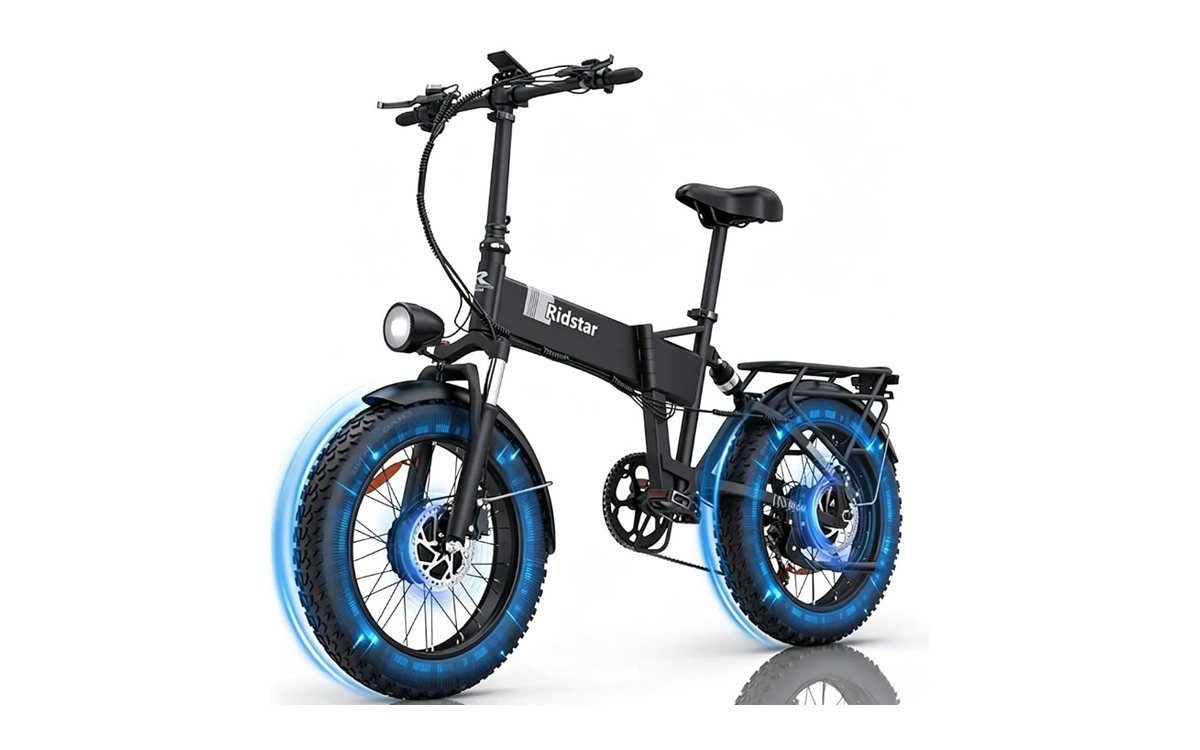
We read RidStar's own listing for the H20Pro on 29 September 2026, checked every number against the federal and state laws that define an e-bike, and ran the maker's performance claims through basic physics. We have not ridden this bike. Where a figure comes from RidStar, we say so. Where the listing contradicts itself, we show both versions.
Research-based score out of 10. The overall score is the average of the four parts below.
- Dual hydraulic disc brakes
- Front and rear suspension
- Large removable 48 V battery
- Folds for storage
- Fits no U.S. e-bike class
- No UL certification claimed
- Listing contradicts itself in five places
- Heavy at 70 lb
The short answer
Consider it if
- You ride on private land, a farm or other property where vehicle rules don't apply.
- You want dual hydraulic disc brakes, front and rear suspension, a removable battery and a folding frame at this price.
- You have read your state's vehicle code and know how it would class this bike.
- You can get RidStar to confirm in writing how the top speed is limited.
Skip it if
- You plan to ride bike paths or multi-use trails.
- It's for a teenager. Many states set 16 as the minimum age for even the fastest legal e-bike class.
- You live in New York City (see battery certification).
- You need spec figures you can rely on without asking the seller.
What the law says
Federal definition
The Consumer Product Safety Act, at 15 U.S.C. §2085(b), defines a "low-speed electric bicycle" as one with operable pedals, a motor under 750 W, and a top speed under 20 mph on motor power alone on a paved level surface with a 170 lb rider. The H20Pro's 2000 W and 31 mph exceed both limits.
That statute is about product safety. Falling outside it does not make the bike illegal to own. It means the question of where you can ride moves to your state's vehicle code.
The three-class system
Most states now use a three-class system modeled on California Vehicle Code §312.5. Every class requires working pedals and a motor of 750 W or less.
| Class | Throttle | Assist stops at | H20Pro |
|---|---|---|---|
| Class 1 | No | 20 mph | Does not fit |
| Class 2 | Yes | 20 mph | Does not fit |
| Class 3 | No (speedometer required) | 28 mph | Does not fit |
The motor rating alone rules out every class. The pure-electric mode counts as a throttle, which also rules out Classes 1 and 3. Limiting the top speed to 28 mph would not turn it into a Class 3 bike, because the 750 W ceiling still applies.
A bike outside the classes is usually treated as a moped or motor-driven cycle. Depending on the state, that can mean registration, insurance, a license or endorsement, a helmet, and no access to bike paths. Rules differ too much for a reliable fifty-state table, so check your own state's code. Our e-bike class guide explains how to read it.
Check any bike's class
E-bike class checker
Runs in your browser| Definition | Rule | Result |
|---|
Thresholds from 15 U.S.C. §2085(b) and California Vehicle Code §312.5. Pre-filled with the H20Pro's listed figures.
Does "0 to 31 mph in 3 seconds" add up?
RidStar's marketing image claims 0–31 mph in 3 seconds, alongside 85 Nm × 2 of torque and a 45° climbing angle. We checked the first claim with the simplest possible physics.
Getting a rider and bike to a speed takes a fixed amount of kinetic energy, ½mv². Divide that by the time and you get the average power needed. Divide again by 0.85 to allow for motor and drivetrain losses. This ignores air drag and rolling resistance, so the real answer can only be higher.
Acceleration check
Minimum power needed| Energy needed at target speed | |
| Average power needed for the claim | |
| Compared with advertised power | |
| Fastest time possible at advertised power |
Example rider weight of 180 lb. Change any figure to match your own.
With a 180 lb rider, the claim needs roughly twice the advertised 2000 W. At 2000 W, the best case is a little over six seconds, which is still quick for a 70 lb bike. We are not saying RidStar is lying. The figure may come from a lighter rider, a downhill start or a peak rating the listing doesn't explain. But you should not expect three seconds.
Where the listing contradicts itself
RidStar's own product page gives different numbers in different places. Here is what we found and which figure we think is right.
| Detail | Headline says | Elsewhere says | Our read |
|---|---|---|---|
| Tire size | 26 × 4 in | 20 × 4.0 in (spec table) | 20 in, matching the folding frame |
| Range | Up to 70 miles | 40–60 mi electric, 50–70 mi assisted | Use the detailed line |
| Gears | 21-speed | Shimano 7-speed (twice) | Unclear. Ask before buying |
| Motors | "2000 Watt" motor | "Dual motor", 85 Nm × 2 | Two motors, 2000 W combined |
| Battery energy | 1000 Wh | 48 V × 23 Ah | About 1,104 Wh by the arithmetic |
Battery safety and certification
Two UL standards matter for e-bikes. UL 2849 covers the bike's whole electrical system. UL 2271 covers the battery pack.
In New York City, Local Law 39 has been in force since 16 September 2023. It bans selling, leasing or renting e-bikes that aren't certified to UL 2849, or batteries that aren't certified to UL 2271. The Department of Consumer and Worker Protection enforces it with the FDNY.
Whatever you ride, charge the battery where you can see it, use the charger that came with it, and stop using any pack that has been dropped, crushed or soaked.
Full specifications
As published by RidStar on 29 September 2026. Model XQSM5.
| Motor | Dual motor, 2000 W peak combined, 85 Nm × 2 |
|---|---|
| Top speed | 31 mph |
| Range | 40–60 mi electric, 50–70 mi pedal assist |
| Battery | 48 V 23 Ah, removable, 4–6 h charge |
| Modes | Electric, pedal assist, pedal only; 5 assist levels |
| Max climb | 45° (claimed) |
| Frame | Aluminum, folding |
| Tires | 20 × 4.0 in fat tires |
| Brakes | Dual hydraulic disc |
| Suspension | Hydraulic front and rear |
| Gearing | Shimano 7-speed (listing also says 21-speed) |
| Weight / max load | 70 lb / 330 lb |
| Rider height | 5′3″ to 6′3″ |
| Included | Charger, tool kit, manual, LCD display, head and tail lights, rear rack and seat, full fenders, phone holder with USB port |
| Warranty | 1 year |
| Price | $1,300.95 |
| Availability | In stock in the US and Canada. EU pre-sale shipping in November. Australia 35–50 days. |
FAQ
Is the RidStar H20Pro street legal?
It depends on your state, but it is usually not legal as a bicycle. Most states would treat it as a moped or motor-driven cycle. Check your state's vehicle code.
Can I limit the speed to make it legal?
Limiting speed helps, but the 750 W motor ceiling still applies, and the throttle rules out Classes 1 and 3. Ask RidStar whether its speed limit is tamper-resistant and get the answer in writing.
Can it really do 0–31 mph in 3 seconds?
The arithmetic says no for a typical adult rider. It would need about twice the advertised power. Expect around six seconds at best.
Does it have one motor or two?
Two. The 2000 W figure is the combined peak.
Is the battery UL certified?
The listing doesn't say. Ask for the certificate number, especially if you live in New York City.
Did you test the bike?
No. This review uses RidStar's published figures, the text of the laws, and our own calculations. We say so at the top of every review where it applies.
Verdict
The H20Pro offers good hardware for $1,301: hydraulic brakes, full suspension, a big removable battery and a frame that folds. It is a reasonable choice for private land and off-road use. It is not a legal e-bike under any of the four U.S. definitions, so avoid it for bike paths, teen riders and New York City. Before you buy, get the gearing, the speed limiter and the battery certification confirmed in writing.
Image and specification credit: RidStar. Not legal advice.