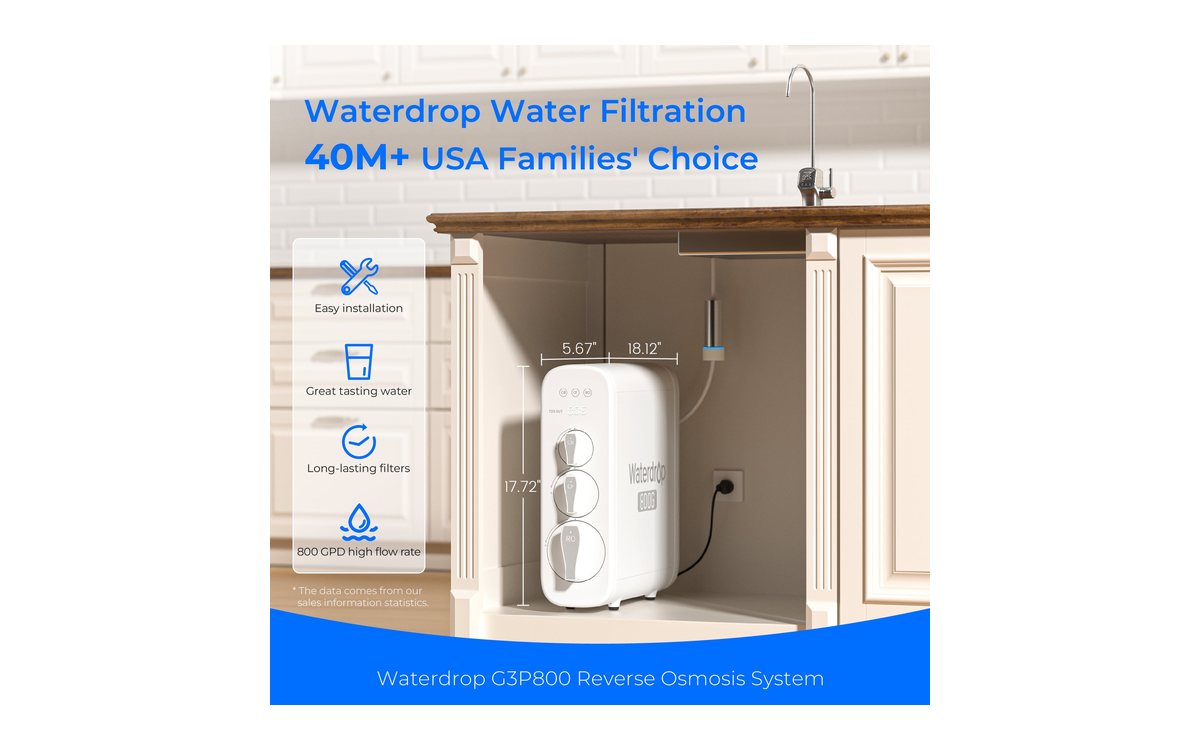
We read Waterdrop's listing for the G3P800 on 9 October 2026 and checked its flow, waste and running-cost figures with a calculator. We have not installed this system or tested its water.
Links to Waterdrop on this page are affiliate links. If you buy through them we may earn a commission at no extra cost to you. Full disclosure.
Research-based score out of 10. The overall score is the average of the four parts below.
- 800 GPD flow matches the maker's own fill-time claim
- 3:1 pure-to-drain ratio
- Tankless, so it frees cabinet space
- Filter prices published up front
- About $160 a year in filters
- Certification scope not spelled out
- Warranty not shown on the part of the page we could read
- Needs power under the sink
The short answer
Consider it if
- You want reverse osmosis water without a storage tank taking over the cabinet.
- You fill pots and bottles often and hate waiting on a slow RO tap.
- You are comfortable replacing three filters on three different schedules.
Skip it if
- You rent and cannot drill a faucet hole or tap the drain line.
- You have no outlet under the sink and do not want to add one.
- You only want better-tasting water. A carbon filter costs far less.
Does 800 gallons a day mean anything?
Nobody drinks 800 gallons a day. The number matters because it sets how fast the tap runs. Divide 800 gallons by the 1,440 minutes in a day and you get 0.56 gallons, or about 71 ounces, per minute.
Waterdrop says the G3P800 fills a 6-ounce cup in 5 seconds. At 71 ounces a minute, 6 ounces takes 5.1 seconds. The two claims agree with each other, which is more than we can say for many listings.
What it costs to keep running
The listing publishes all three replacement filters with their lifespans, so the yearly cost is easy to work out.
| Filter | Replace every | Price | Cost per year |
|---|---|---|---|
| G3-N1CF | 6 months or 550 gal | $29.99 | $59.98 |
| G3-N3CB | 12 months or 1,100 gal | $29.99 | $29.99 |
| G3P800-N2RO membrane | 24 months or 2,200 gal | $139.99 | $70.00 |
| Total | about $160 |
Over five years that is about $800 in filters on top of the $999 purchase, or roughly $1,800 all in. The gallon limits also tell you something: 1,100 gallons a year is about 3 gallons a day. A big household that cooks with RO water will hit the gallon limit before the calendar date.
The page offers a filter subscription and describes the saving two ways, "Save 5%" and "Up to 10% off". The prices shown work out to 5%.
Waste water and certifications
A 3:1 pure-to-drain ratio means one gallon goes down the drain for every three you drink. Over the 2,200-gallon life of the membrane that is about 730 gallons of waste. Older tank systems often waste more water than they produce, so this is a good figure.
The listing states "NSF/ANSI 42, 53, 58, 372 certified". Those standards cover taste and odor (42), health-related contaminants (53), reverse osmosis systems (58) and lead-free materials (372). What the page does not say is which contaminants were tested under each one. A system can hold standard 53 for a single contaminant. Before relying on a specific claim such as PFAS or lead reduction, look the model up in the NSF or IAPMO public listings.
Key facts
As published by Waterdrop or the sources named above, checked on 9 Oct 2026. Prices and terms change, so confirm them before you buy.
| Type | Tankless under-sink reverse osmosis |
|---|---|
| Rated flow | 800 gallons per day |
| Fill speed (claimed) | 6 oz in 5 seconds |
| Pure-to-drain ratio | 3:1 |
| Filtration | 10 stages across three cartridges |
| Certifications claimed | NSF/ANSI 42, 53, 58, 372 |
| Filters | G3-N1CF, G3-N3CB, G3P800-N2RO |
| Returns | 30 days (site banner) |
| Price | $999.00 list; $849.00 with an on-page code when we checked |
FAQ
Is the Waterdrop G3P800 worth it?
It is if you want fast RO water and have power under the sink. Budget about $1,800 over five years including filters.
How much do G3P800 filters cost per year?
About $160 at the prices on Waterdrop's listing, if you follow the stated replacement schedule.
Does it remove PFAS and lead?
The listing says so and cites NSF/ANSI 53 and 58. It does not show which contaminants each certificate covers, so check the public certification listing for this model.
Did you test the water?
No. This review checks the maker's published figures. We did not install the system.
Verdict
The G3P800's headline numbers hold together, and Waterdrop deserves credit for publishing filter prices and lifespans openly. Treat it as an $1,800 five-year purchase, confirm the certification scope for the contaminant you care about, and make sure there is an outlet under your sink.
Product names and trademarks belong to their owners. This review is general information, not professional advice.